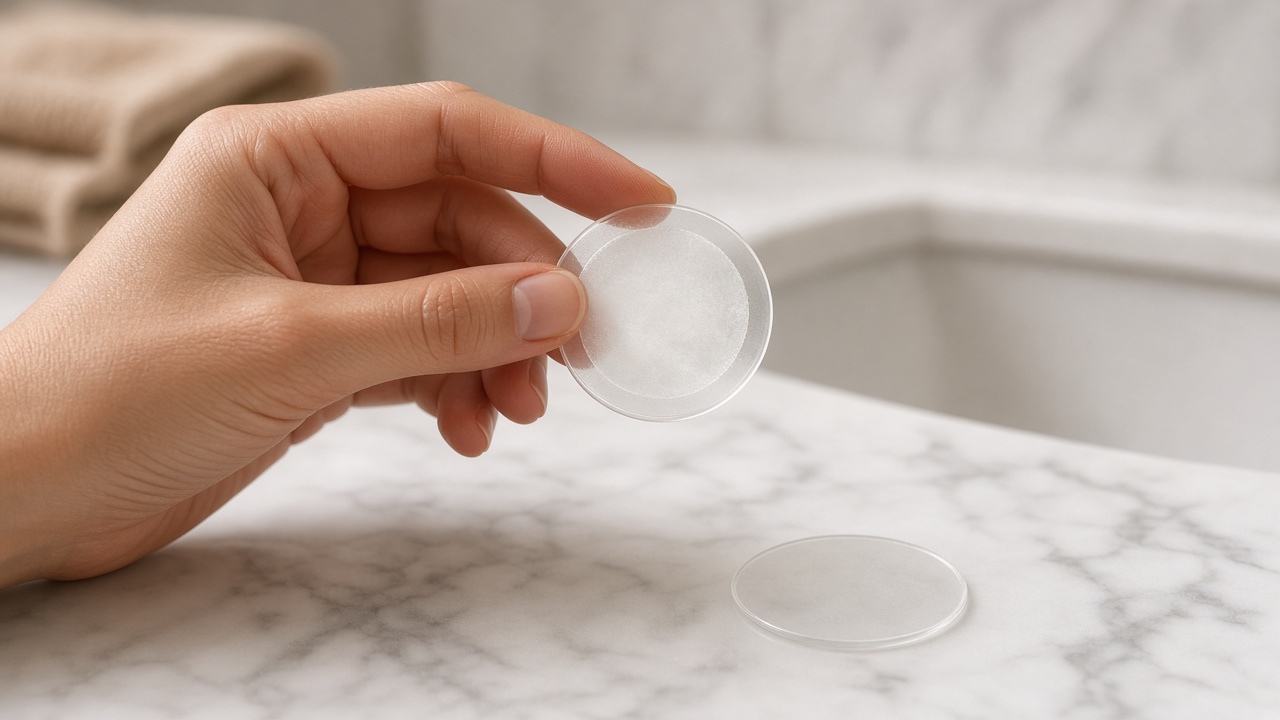
The job this morning is not to decide whether last night’s hydrocolloid “worked”. It is to read the disc you just peeled: cloudy white in the middle, still clear, or a mix — and to know which of those is a reason to buy another pack, switch format, or leave the aisle alone.
A white centre is what hydrocolloid does when it has fluid to collect. A still-clear centre is what it does when it does not. Neither is a report card on COSRX versus Mighty Patch. Both are cheap round dressings, roughly 15–40p a disc. The colour change is the job, not the logo.
Hydrocolloid is a thin sticky dressing for a whitehead, an open spot, or anything already weeping. It does not flatten a closed bump, and it does not replace a GP for anything deep, painful, cystic, or recurring. The hydrocolloid vs microdart comparison is the 60-second fork if you still need it.
What the white centre actually is
The unused disc is clear. Overnight, the dressing can take up fluid from the surface of the spot. That fluid clouds the gel. By morning the middle looks milky, opaque, or a small white blob sitting in a still-clear rim.
That is collection, not a cure. The patch sat on something that had fluid at the surface and held some of it. The white mark does not mean the spot is finished, and it is not a reason to pick what is left.
A ring of white with a clear edge is ordinary: the middle sat on the fluid, the rim sat on dry skin. A disc that is white all the way out may have been a tight size, or the spot was already leaking under a larger area. Neither pattern is a reason to switch brand.
Bin it. Hydrocolloid is single-use. A white disc is full of what it collected, plus skin oils on the adhesive. It does not go back on.
A still-clear disc is information
If the patch stayed on and stayed clear, start with the simplest read: there may not have been surface fluid to collect.
A closed, early, under-the-skin bump has nothing for a hydrocolloid dressing to pull. The disc can hold overnight and still look unused. That is not a dud pack. It is the wrong format. The next spend, if you spend at all, is a microdart — dissolving cones aimed at a closed bump, typically £0.60–£2.50+ each, so check the retailer before you stock up.
Other ordinary reasons a disc stays clear:
The patch was only on for an hour. Hydrocolloid’s usual window is six to twelve hours, or overnight. A lunchtime sticker that you peel before a meeting has not had a night’s worth of contact.
Moisturiser, oil, serum, or SPF sat under the adhesive. The dressing needs dry skin. A slip layer can keep the gel off the fluid even when the spot looks right for the format.
The disc missed. Too small and the edge sits on the fluid while the middle sits on clean skin. Off-centre and you dressed the cheek next to the whitehead.
A still-clear disc that peeled off at 2am is a hold problem, not a colour problem. Dry the skin, skip the moisturiser on that exact patch, and size a rim of clean skin. The overnight apply guide is the step-by-step for that.
It is not a score for the brand
People swap COSRX for Mighty Patch because one disc went white and the other stayed clear. Same format. Same job. The cloudy one sat on fluid; the clear one did not. You did not discover a cleverer gel.
Microdart patches do not turn white the same way. They are a cone array, not a fluid dressing. Judging a microdart by whether the backing went milky is reading the wrong signal. An under-eye dissolving pair is a different format again — pounds per wear, not pence, and not a spot sticker.
If last night’s disc went white and the spot still looks angry, that is not a prompt to stack a second disc “to finish it”. Cover it again only if there is still fluid at the surface and the skin is comfortable. If it looks worse — more painful, spreading, or you feel unwell — stop and see a GP.
When to leave it, switch format, or see a GP
Leave a comfortable hydrocolloid on for the night. Do not peel every hour to check for white. Checking is how you lift an edge that would have held.
Switch format when the disc stays on and stays clear on a closed bump. Do not buy a thicker hydrocolloid for that. Thickness helps a pillow-side cheek; it does not invent fluid that is not at the surface.
See a GP when the bump is deep, sore, cystic, or it keeps returning in the same place. A white disc on top of that is still a sticker. A clear disc on top of that is still a sticker. Neither is treatment.
If you have already picked the spot, a hydrocolloid can cover what is open and collect what is there. The white centre, if it comes, is the same collection signal — it cannot rewind the pick.
Where to buy in the UK
Everyday hydrocolloid is the cheap format: roughly 15–40p a patch, though pack prices move. COSRX Master Patch (Amazon UK) is a 24-patch mixed-size sheet, often listed around £5.99 — Superdrug is the other named path; check the retailer on the day. Mighty Patch Original shows up at Boots, Hero UK, Tesco, and Amazon UK, typically in a 36-pack. Stockist notes live on where to buy hydrocolloid patches.
A white disc does not mean you needed the dearer box. A clear disc does not mean you needed a different logo. More comparisons sit in all guides. If you are still choosing a format rather than reading last night’s sticker, start with hydrocolloid vs microdart.