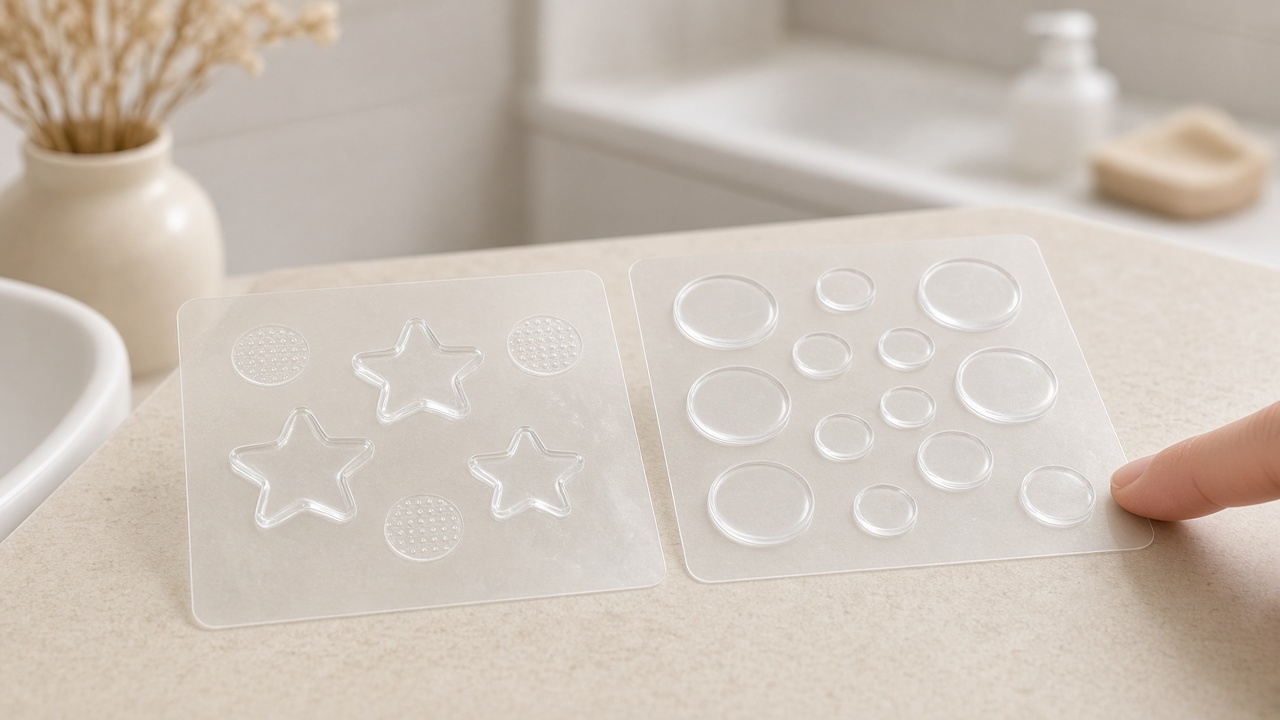
You have a whitehead, or a spot that is already open, and two packs in front of you. One is stars or tiny dots. The other is plain round discs. The useful question is whether the outline changes what the sticker does, or only how it looks and what you pay per patch.
If the middle is plain hydrocolloid — a clear sticky dressing, not a cone — both packs do the same job. They sit on a whitehead, an open spot, or anything already weeping, and they collect fluid that is already on the surface. Points on a star do not collect extra fluid. A small dot collects the same way, as long as it covers the spot.
Everyday hydrocolloid on this site sits around 15–40p a patch. COSRX Master Patch is often listed around £5.99 for 24, about 25p a disc. Mighty Patch Original is often around £10–12 for 36, or about £8.79 for 36 at Boots, nearer 24–33p. A novelty sheet can look cheap at the till and still come out dearer once you divide by the stickers you will actually use. Check the retailer on the day.
The outline does not change the job
An unused hydrocolloid sticker is usually clear. If there is fluid at the surface, the middle can turn cloudy or white by morning. That colour is collection. You read it the same way on a star, a dot, or a round disc. The white-centre guide covers the colour.
A tint, a printed dot pattern, or a solid colour can hide that cloud. You then cannot tell whether the dressing collected anything. A clear sticker is the one you can read in the morning.
The format stays with the spot, not the silhouette. A closed early bump still has nothing for hydrocolloid to collect. Anything deep, painful, cystic, or repeating is a GP visit. If you are still choosing a format, use the hydrocolloid vs microdart comparison.
Count, rim, and whether you can see it
Start with the stickers you will use. A novelty sheet often mixes stars and tiny dots. A dot that misses a rim of clean skin around the spot stays on the sheet. Divide today’s price by the ones that fit, not by the number on the box.
A plain disc wants a small border of dry skin all the way round. A star has points, and each point is more edge. On a flat cheek that can sit fine. Beside the nose, in a chin crease, or along the jaw, a point catches a fold, a pillow, or a collar more easily than a round rim. If the sticky edge lands in fluid, either shape lifts. The peel-off guide is what to check when the sticker is on the pillow by morning.
A clear round disc is what people try to hide under makeup. A star is cut to be seen. If you want the patch to disappear, buy the plain disc. The makeup guide is about a thin clear patch under foundation.
Wash the spot. Skip moisturiser, serum, oil, and SPF on that exact patch. Press the middle, then the edge, including the points. Leave it for six to twelve hours, or overnight. The overnight apply guide is the same steps for a star and for a plain disc. If a point folds as you peel it off the backing, bin it and take another. You use each sticker once.
When the novelty pack is the wrong buy
Leave the stars and dots when the bump is still closed under the skin. There is no surface fluid to collect. If a plain disc stayed on, stayed clear, and the bump never came to a head, the next format — if you buy one — is a microdart. On this site those cones are typically £0.60–£2.50 or more each. Keep cones off a spot that is already open or weeping.
Skip the novelty sheet when every sticker is smaller than the spot, when the points will sit on a fold that already lifts patches, or when you need to see the centre change colour. A first kit here is one plain hydrocolloid and, only if you also get closed bumps, one microdart. The first kit guide says to wait on a star until a round disc already does the job.
See a GP if the spot is deep, very sore, cystic, or it keeps coming back.
Wording such as salicylic or “active” on a novelty box is a line on the carton. Match hydrocolloid or microdart to the spot in the mirror.
Pence per sticker, not the fun box
Write the till price down. Count only the stickers that cover a spot with a clean rim. Divide.
Inside 15–40p, you are choosing the outline. Well above 40p, you are paying named-pack money, or more, for a shape. A plain COSRX sheet or a Mighty Patch box is usually the cheaper way to get the same dressing.
This site does not keep a live novelty price. Some sheets pad the count with dots you will not peel. Check the pack in front of you, then do the division.
Where to buy in the UK
Shaped hydrocolloid turns up in Boots, Superdrug, and online. Read the front for the word hydrocolloid and for discs you can peel off a sheet. If the box is dissolving cones, put it back. You came for a dressing.
To set a novelty price against a plain mixed-size sheet, COSRX Master Patch (Amazon UK) is a 24-patch pack, often listed around £5.99. Superdrug is the other named path for it. Mighty Patch Original is the one-size 36-pack, often around £10–12, with Boots nearer £8.79 for 36, plus Hero UK and Tesco. Stockist notes are on where to buy hydrocolloid patches.
More pack notes sit in all guides. If you are still choosing a format rather than a shape, start with hydrocolloid vs microdart.